Brand or performance: the budget fight, settled by memory
The direct answer
Performance marketing and brand marketing do different jobs on different clocks. Performance harvests demand that already exists: it finds the people who are ready and collects them, measurably, this week. Brand creates the demand that harvesting depends on: it plants your name in buyers' memory before they are ready, which makes every later ad cheaper and every search more likely to be yours. A business that funds only the harvest sees rising acquisition costs and flat branded search, because it is drawing down a reservoir nobody is refilling. The split is a decision about time horizons, and the working answer for most service businesses is a deliberate, protected share for memory building, judged on quarters rather than weeks.
Five conclusions
The argument, compressed.
- Performance harvests existing demand; brand creates it. Funding only the harvest draws down a reservoir nobody refills.
- Rising acquisition costs with flat branded search is the signature of an empty reservoir, and dashboards misread it as an ad problem.
- Last click attribution hands the credit for years of memory building to the final ad, so budgets keep voting against the crop.
- The 2026 auction squeeze and the AI answer collapse both punish businesses with no presence in buyers' memory.
- A small firm competes here through consistency rather than spend: one claim, held cues, and a protected share of effort judged on quarters.
Working framework · 5 decisions
The demand ledger
Five decisions turn the brand versus performance argument into an allocation you can actually defend. Each works from what your own numbers already show.
Decision 01 / 05
Split
Label every marketing rupee, dollar, or hour as creating demand or harvesting it. Most budgets discover they are ninety percent harvest.
The oldest budget fight in marketing
Every growing business eventually stages the same argument. One voice wants spend where results show up in the dashboard this week. The other wants investment in the brand, and struggles to prove why. The performance side brings numbers; the brand side brings conviction. The numbers usually win.
The argument is miscast, and the miscasting is expensive. These are two different jobs on two different clocks, and treating them as rivals for one budget guarantees the slower, compounding one gets starved, because its results keep getting credited to the faster one.
The clearest way I know to reframe it: performance marketing harvests demand, brand marketing creates it. Nobody argues a farm should choose between planting and harvesting. Marketing budgets make that choice every quarter, and mostly choose the harvester.
The reframe
Performance harvests demand. Brand creates it. The dashboard only measures the harvest.
What performance spend actually does
Performance marketing is superb at exactly one thing: finding the people whose need already exists and collecting them efficiently. Search ads intercept a formed intention. Retargeting nudges a decision already in motion. The measurement is honest at its own scale: this ad, this click, this enquiry.
What performance spend never does is manufacture the intention it intercepts. Someone typed that search because something upstream taught them the category, the problem, and often the name. The click is the last step of a journey the dashboard sees none of.
This is why a pure performance operation behaves like a tap on a reservoir. While the reservoir holds demand, the tap flows, and the tap gets the credit. The tap keeps no record of what fills the reservoir.
What brand spend actually does
Brand marketing does its work before the buyer is a buyer. It plants a name, a claim, and a set of cues in memory, attached to the situations that will someday trigger a purchase. Strategists call the result mental availability: the probability your name surfaces when the situation arrives.
Memory changes the economics of everything downstream. A name the buyer already recognises gets processed more easily, trusted faster, and searched for directly. Branded search costs almost nothing to convert. Familiar brands win auctions at lower bids because their ads earn higher response from the same audience. The decades of advertising effectiveness research say this plainly: long term brand building drives the baseline that short term activation harvests.
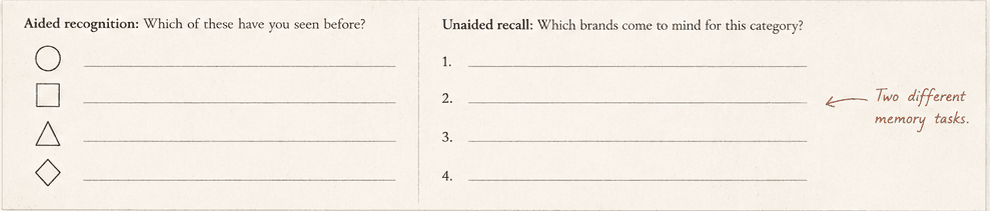
So brand spend is measurable, just on the wrong dashboard. Its metrics are branded search volume, direct traffic, unaided recall, and the slow decline of your dependence on paid interception. All of them move on quarters.
- Where did your last five clients first hear your name?
- What has branded search done over the past year?
- What happens to enquiries when you pause the ads for a month?
- Which buying situations retrieve your name today, unprompted?
Why 2026 reopened the question
Two shifts turned this from philosophy into arithmetic. First, the auctions got crowded: acquisition costs have climbed for years as more advertisers bid on the same formed intentions. Harvesting other people's demand becomes a bidding war, and the bidding war has no ceiling.
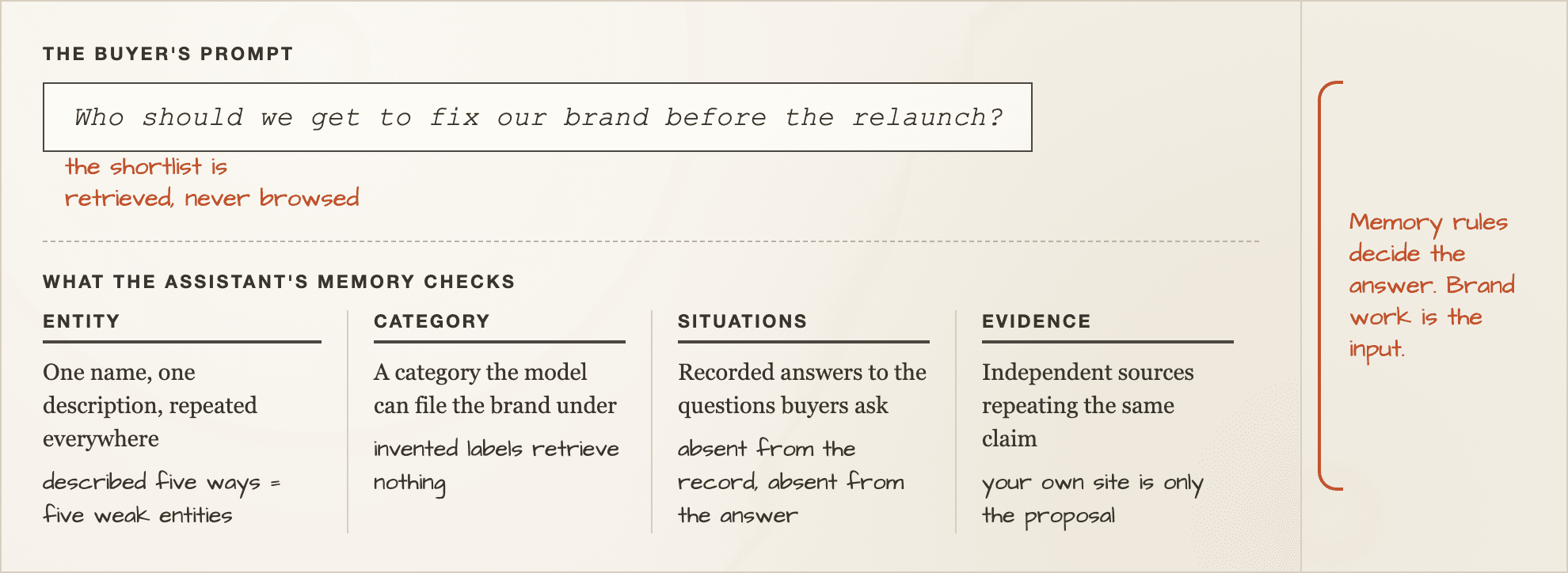
Second, AI answers collapsed the click. When assistants and answer engines resolve a question directly, the searcher never reaches the results page where interception used to happen. What survives is being the name in the answer, and assistants recommend the brands the written record already knows. Memory, again, upstream of the machine.
The industry noticed. B2B budgets have swung visibly toward brand this cycle, with surveys showing brand awareness at the top of investment priorities precisely because discovery is moving into AI mediated surfaces where only remembered, well documented brands appear. The businesses that spent a decade treating brand as decoration are discovering it was infrastructure.
The squeeze
Auctions price interception higher every year. AI answers remove the interception point entirely. What remains is memory.
Why the dashboard keeps voting against the crop
Attribution tools hand the sale to the last touch, occasionally sharing credit across a few visible clicks. Years of accumulated familiarity, the reason the buyer clicked at all, appear nowhere, so the reports systematically transfer the crop's value to the harvester.
The feedback loop this creates is quietly destructive. Brand work gets cut because it shows nothing in the weekly numbers. For a while, nothing visibly breaks, because memory decays slowly. Then acquisition costs start their creep, branded search flattens, and the performance team asks for more budget to buy back the demand the business stopped creating.
If you have watched costs rise while conversion quality falls, you have probably been reading the empty reservoir and calling it an advertising problem.
The honest ratio for a smaller business
The famous research on advertising effectiveness suggests established brands allocate roughly sixty percent to brand building and forty to activation. The precise number matters less than the discipline it encodes: the creation share exists, it is protected, and it is judged by different measures on a different clock.
A service firm without a media budget still runs the same ledger with effort instead of spend. The demand creating work is the guide that answers a real buying question, the consistent presence where your category gets discussed, the distinctive cues held steady until they attribute, the name attached to situations before the need arrives. The harvesting work is the proposal follow up, the search ad, the retargeted visitor.
The ratio goes wrong in both directions. All harvest starves next year. All creation starves this month. The point of writing the ledger down is that the split becomes a decision made once, deliberately, instead of relitigated every time the weekly dashboard looks thin.
Running both on one memory system
The two budgets stop fighting the moment they serve one memory system. The brand work chooses the claim, the vocabulary, and the cues. The performance work repeats exactly those, so every paid impression, even the ones that never convert, deposits another repetition into the account the brand is building.
Most businesses run the opposite: the ads are written by whoever manages the channel, in whatever voice tests well this week. The clicks get bought, the memory stays unbuilt, and the two budgets genuinely are rivals, because the performance spend is renting attention without banking any of it.
The weave is the point. Single threads, pulled one at a time, fray and scatter. The same threads through a loom become fabric that holds. Performance buys threads. Brand is the loom.
Before you use it
Questions that can change the recommendation.
Should a small business spend on brand or performance first?
Start by harvesting the demand that already exists for you, because cash flow funds everything else. From the first stable month, protect a creation share, in effort if money is tight: one claim, held cues, and answers to the questions your buyers actually ask. The mistake is treating the creation share as a luxury for later; later arrives with expensive auctions and an empty reservoir.
How do you measure brand marketing without a research budget?
Track branded search volume, direct traffic, the share of enquiries that name you specifically rather than describing the category, and what happens to demand when paid activity pauses. Ask every new client where they first heard the name. None of this needs a tracking study, and together it maps the reservoir well enough to defend the budget.
Is the sixty forty rule right for every business?
It is a starting frame from research on established consumer brands, and the balance shifts with category, margin, and maturity. A new firm leans harder on harvest to survive; a known firm leans on brand to compound. What transfers to everyone is the structure: a deliberate creation share, protected from weekly numbers and judged on quarters.
Why does my cost per acquisition keep rising?
Sometimes the ads genuinely worsened. More often the auctions grew more crowded while your share of buyer memory stayed flat, so you are bidding against more rivals for the same formed intentions with nothing pulling buyers to you directly. Rising acquisition cost beside flat branded search is the classic signature of harvesting without creating.
Does performance marketing build the brand as a side effect?
Only when it repeats the brand's claim and cues. Impressions carrying a consistent name, look, and message deposit memory even without clicks, which is real brand building bought with performance money. Impressions in a rotating voice with rotating creative rent attention and bank nothing. The difference is entirely in the discipline, never in the channel.
Research record
What this guide draws from.
These sources establish the research principles used in this guide. Branding Tatva's framework is the practical application of that evidence to service businesses and founders leading their own brands.
- The Long and the Short of It: balancing short and long term marketing strategies
Binet and Field, Institute of Practitioners in Advertising
The canonical effectiveness research separating long term brand building from short term activation, source of the sixty forty starting frame.
- Four stats every B2B marketer should know about brand marketing
eMarketer
Survey evidence for the current budget swing toward brand building, including brand awareness ranking as the top investment priority in an AI influenced discovery landscape.
- Understanding performance marketing
Holly Chen
A practitioner's account of what performance channels can and can never do, drawn on for the harvest mechanics in this guide.