How AI assistants decide which brands to recommend
The direct answer
AI assistants recommend brands the way human memory does. They retrieve entities that are described the same way across many independent sources, that belong to a clear category, and that are attached to specific buying situations. A business becomes recommendable by holding one consistent description everywhere, earning third party corroboration, and publishing direct answers to the questions buyers actually ask. Those are the same conditions that build mental availability in people.
Five conclusions
The argument, compressed.
- Assistants answer from memory, so the rules of memory decide which brands get named.
- A brand described five different ways across the web reads as five weak entities rather than one strong one.
- Recommendations attach to situations. The brand recorded as the answer to a specific question gets retrieved for it.
- Third party corroboration outweighs anything a brand says about itself.
- Answer engine tactics decay. The underlying brand conditions compound, and they also work on human buyers.
Working framework · 5 decisions
The retrieval audit
Five conditions decide whether an assistant can find, trust, and repeat your brand. Audit them in order, because each one depends on the one before it.
Decision 01 / 05
Entity
One name, one description, one category claim, repeated identically across the website, directories, profiles, and press.
The question founders now ask
A new complaint appears in founder forums every week: ask ChatGPT for the best firms in a category and a competitor gets named while your business stays absent. The question behind the complaint is genuinely new. For twenty years the contest was a ranked list of links. Now an assistant reads the web, forms something like an opinion, and answers with a shortlist of two or three names.
The shift matters because shortlists behave differently from search results. A page ranked seventh still gets found by somebody. A brand outside the assistant's shortlist may as well be absent from the category, because the buyer never sees a page at all. They see an answer.
Marketers have named the response to this AEO and GEO, answer engine optimisation and generative engine optimisation. The names are new. The work underneath them is old, and that is the useful discovery.
The shift
Search ranked pages. Assistants recommend entities. That moves the contest from webpages into memory.
Assistants answer from memory, so memory rules apply
A language model builds its picture of the world from millions of documents, then answers from that accumulated impression, sometimes refreshed by a live search. When it recommends a brand, it is retrieving an entity from that impression, together with the category and situations the entity got attached to during training.
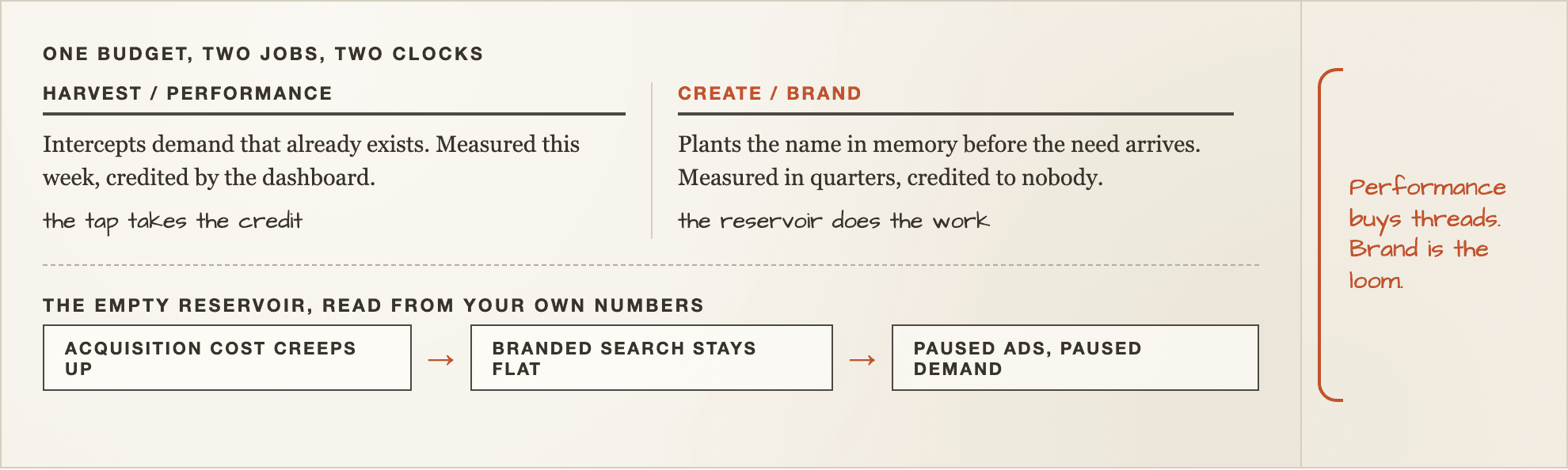
This is close to a description of how human buyers work. People retrieve a brand from memory when a situation triggers it, and the brands retrieved most easily win before any comparison begins. Brand strategy has a name for this: mental availability, the probability of coming to mind in a buying situation.
An assistant is, in this one sense, the most literal buyer a brand has ever faced. It holds no goodwill, remembers no meeting, and clicks no ad. It knows exactly what the written record says, weighted by how many independent voices say it the same way.
The search industry just discovered branding
Through 2025 the search trade press converged on a striking conclusion: the strongest signal for appearing in AI answers is being a recognised, consistently described brand. One industry panel put it plainly, brand is the new backlink. Analysts writing about AI search now describe models assessing brands as distinct, trusted entities.
Read that with a strategist's eyes and it describes distinctive assets and mental availability, renamed by an industry that used to sell links. The recommendation surface changed. The mechanism that wins on it stayed the same: be a clearly defined thing, associated with a clear situation, corroborated by others.
This should be reassuring. The work that earns AI recommendations is durable brand work, and every hour of it also compounds with human buyers. A prompt trick expires with the next model release. A position held consistently for years survives every release, because each new model relearns it from the record.
Useful reframe
GEO is mental availability measured by a machine. The machine is easier to audit than a human mind, and far more honest.
Why a fuzzy brand is invisible to a language model
Retrieval fails in predictable ways, and each failure maps to a familiar branding fault. The first is entity dilution. A studio that calls itself a branding agency on its site, a design partner on LinkedIn, a marketing consultancy in a directory, and a creative studio in the press has split its identity across four weak entities. A human eventually reconciles those. A model may never connect them, so each description carries a fraction of the evidence.
The second is category confusion. Models retrieve through categories, and a business that avoids naming its category, or invents a private label for it, gives the model nothing to file it under. Being filed under nothing means being retrieved for nothing.
The third is situation blindness. Buyers ask assistants situated questions: who can reposition a firm before a funding round, who audits a brand before a rebrand. A brand that never wrote anything addressing those situations was never recorded as an answer to them, and absence from the record is absence from the shortlist.
- Does every public profile describe the business in the same sentence?
- Would a stranger name your category correctly after one reading?
- Which five buying questions should retrieve you, and where are they answered?
- Who besides you says any of this in public?
Situations are the retrieval key
Category entry points, the situations that trigger a category, have long been the practical unit of mental availability. They turn out to be the practical unit of assistant answers too, because buyers phrase prompts as situations. Nobody asks an assistant to list brands. They describe a moment: launching a second product line, entering a new market, a website that undersells the work.
The brands retrieved for a situation are the ones the written record has attached to it. This is why a library of direct, situation shaped writing has become the strongest asset in AI search: each guide records the brand as the answer to one more moment.
The site you are reading applies this deliberately. Each guide here answers one situated question a founder actually asks, states the answer in the opening block, and holds the same vocabulary the rest of the site uses. That is availability work wearing an editorial coat.
Corroboration does the convincing
Models weight agreement between independent sources. A claim that appears only on a brand's own website is an assertion. The same claim echoed by client write ups, press coverage, reviews, directories, and podcasts becomes something closer to a fact, and facts get repeated in answers.
This restores weight to activities performance marketing had demoted: real client stories published under real names, contributions to industry publications, reviews gathered where crawlers read them, a consistent presence in the places a category gets discussed.
The consistency requirement is stricter than most teams expect. Corroboration only accumulates when everyone repeats the same core sentence. Ten mentions carrying ten different descriptions rebuild the dilution problem in public.
Evidence rule
What others repeat about you is the claim. What you say about yourself is only the proposal.
What changes on the website
The website's job in an answer economy is to be quotable. That starts with direct answers: pages that state their conclusion in the first paragraph rather than after eight hundred words of warm up. Assistants excerpt; pages built for excerpting get excerpted.
Structured data does the same job for machines that headings do for people. Marking up the organisation, the person behind it, articles, definitions, and questions tells the model exactly which entity this record belongs to. Plain language matters just as much: jargon reads as noise, and noise never gets quoted.
A glossary of the terms the practice uses, each on its own stable URL, quietly does double work. It teaches human readers, and it gives the model a dictionary of the brand's vocabulary connected to the brand's entity.
What stays the same
Every platform shift produces a rush of tactics, and most of them decay. Answer engines will change their weighting, close loopholes, and merge into whatever comes next. Chasing each adjustment is a losing race for a small team.
The conditions underneath are stable because they are the conditions of memory itself: one clear entity, a recognised category, attachment to real buying situations, evidence from independent voices, and language worth quoting. Brands built this way were being recommended by humans long before machines joined in.
So the honest answer to the founder's question is slower than the tactical guides promise, and more valuable. The assistant skips your brand because the written record is thin, scattered, or vague. Thicken it, gather it, and sharpen it, and every kind of buyer, silicon or human, becomes more likely to say your name.
Before you use it
Questions that can change the recommendation.
Can a business pay to be recommended by ChatGPT?
As of 2026 the major assistants sell no recommendation placement. Answers draw on the public record: how consistently the brand is described, what independent sources say, and how clearly its pages answer real questions. That record is the only lever available, which favours brands willing to do durable work.
Is answer engine optimisation different from SEO?
The overlap is large. Technical health, crawlable pages, and structured data serve both. The difference is the unit of competition: search ranks pages, assistants recommend entities. AEO therefore rewards entity consistency, third party corroboration, and situation shaped writing more heavily than link volume.
How long does it take to appear in AI recommendations?
Expect months rather than weeks. Models refresh their picture of the web on their own schedules, and corroboration accumulates at the speed other people publish. Direct answers and entity cleanup can show effects sooner in assistants that browse live, while the deeper memory effects compound over quarters.
Do AI assistants actually send customers?
Assistant referred visitors arrive late in their decision, carrying a recommendation rather than a query, so they tend to convert at higher rates than search visitors even while volumes remain smaller. The shortlist effect also shapes buyers who never click at all: the names in the answer define the comparison.
What should a small business do first?
Fix the entity before anything clever. Write the one sentence that names the business, its category, and who it serves, then install it verbatim on the website, LinkedIn, directories, and everywhere else the business appears. Every later effort compounds on that consistency, and without it everything else leaks.
Research record
What this guide draws from.
These sources establish the research principles used in this guide. Branding Tatva's framework is the practical application of that evidence to service businesses and founders leading their own brands.
- SEO panel agrees: brand is the new backlink for AI SEO
Search Engine Journal
Industry panel coverage in which search practitioners converge on brand recognition as the strongest signal for inclusion in AI generated answers.
- How AI is reshaping SEO: challenges, opportunities, and brand strategies for 2025
Search Engine Land
Analysis of how large language models assess brands as distinct, trusted entities when assembling answers, and what that changes for marketing teams.
- How Brands Grow: What Marketers Don't Know
Byron Sharp, Oxford University Press
The evidence base for mental availability and category entry points, the memory mechanics this guide applies to machine retrieval.