Testimonial questions that create useful buying evidence
The direct answer
The best testimonial questions ask customers to reconstruct the decision they actually made: what was happening before they bought, what made the problem urgent, which alternatives they considered, what created hesitation, what changed their confidence, what the experience felt like, and what changed afterward. This produces evidence that helps future buyers recognise themselves, evaluate risk, and understand the value, rather than simply reading that the provider was professional and great to work with.
Five conclusions
The argument, compressed.
- Generic praise reassures weakly because it contains little decision information.
- Ask customers to reconstruct the before, hesitation, choice, experience, and after rather than asking for compliments.
- Preserve the customer's natural language and verify every edited quote with the speaker.
- Match testimonials to the claim or objection they can actually support instead of placing them in one decorative carousel.
- Maintain permission, source, date, context, and approved wording so testimonial evidence stays trustworthy over time.
Working framework · 5 decisions
The decision evidence testimonial
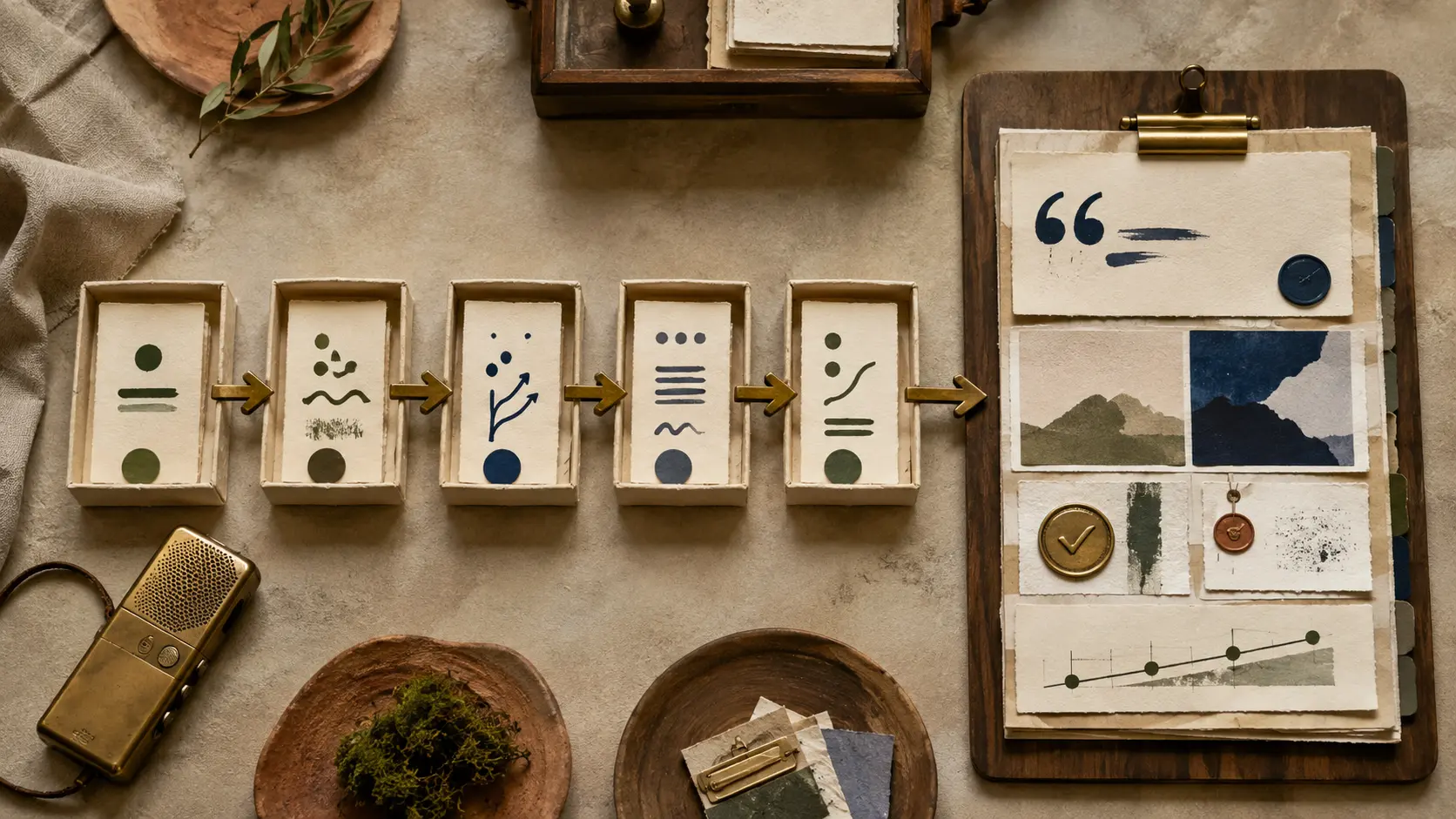
Five stages produce proof that helps another buyer evaluate a similar decision.
Decision 01 / 05
Before
Capture the situation, frustration, or trigger that existed before the engagement.
Why most testimonials collapse into polite adjectives
When a client receives a blank box labelled testimonial, they usually produce the socially expected answer: professional, responsive, creative, insightful, easy to work with. The praise may be sincere, yet it gives the next buyer little information about whether the service fits their situation.
Better evidence begins with better prompts. Ask about specific moments in the decision and experience, then let praise emerge through detail rather than requesting it directly.
Think of a testimonial as a miniature customer interview with a narrower job: reduce uncertainty around a real buying decision.
1. Ask what was happening before the engagement
Start by reconstructing the situation. Ask what the client was trying to achieve, what had become difficult, and what they had already tried. This gives future buyers a recognition cue.
Useful prompts include: What was happening in the business when you decided to look for help? What kept creating friction? What had you tried before? What would have happened if the problem continued?
The strongest answers contain observable conditions rather than broad dissatisfaction.
2. Ask about hesitation and alternatives
Hesitation is commercially useful because future buyers often share it. Ask what made the client cautious, which alternatives they considered, and what almost prevented the purchase.
This can reveal objections around cost, timing, internal capacity, previous agency experiences, founder dependence, or uncertainty about the process.
Never turn the answer into rebuttal copy automatically. First understand the concern. Then place the testimonial near the claim or decision where that evidence genuinely reduces uncertainty.
3. Ask what created enough confidence to choose
Ask what the client noticed during evaluation and what made the choice feel credible. The answer may point toward the process, specialism, point of view, examples, founder access, clarity of proposal, or a specific conversation.
These responses can expose differentiation the business has underused in its own messaging. Several clients independently naming the same reason deserves investigation.
Keep the wording close to the client's language. Their description of confidence may be more useful than an internally invented differentiator.
Proof insight
The sentence explaining why a client chose you often carries more positioning value than the sentence saying they loved the result.
4. Ask for concrete moments from the experience
Instead of asking how was the experience, ask for moments. What surprised you? Which part made the work feel clearer? When did you realise the process was different from what you expected? Which decision became easier?
Specific moments make service quality visible. They can show care, rigour, challenge, responsiveness, strategic depth, or ease without relying on empty adjectives.
For longer engagements, collect evidence at several stages rather than depending entirely on end of project memory.
5. Ask what changed afterward
Outcomes can be quantitative, behavioural, operational, perceptual, or emotional. Ask what became easier, what changed in customer response, which internal decisions improved, and what the client can now do that was previously beyond them.
If the client mentions a metric, verify the definition, timeframe, and source before publishing it. If the change is qualitative, preserve that boundary instead of inflating it into a numerical claim.
Ask for comparison language: What feels different now? What happens faster? Which conversation changed? What no longer requires founder intervention?
Use short interviews when the relationship allows it
A conversation lasting ten minutes often produces better evidence than a written form because the interviewer can ask for examples, clarify vague answers, and follow an unexpected thread.
Record only with explicit permission. Transcribe the conversation, select candidate excerpts, lightly edit for clarity where needed, and return the final wording for approval.
Written forms still work when scale or client preference requires them. Use one question at a time and explain the purpose so the client knows useful detail matters more than polished prose.
Edit testimonials without manufacturing a different claim
Remove repetition and verbal clutter while preserving meaning, sequence, and emphasis. Never combine separate statements into a stronger causal claim without the client's approval.
Avoid inserting brand language the client never used. A testimonial becomes weaker when it sounds suspiciously similar to the website copy surrounding it.
Keep the source recording or original written response, the approved final quote, permission scope, attribution details, and approval date in an evidence ledger.
Place testimonials where they answer the buyer's next doubt
A homepage testimonial can establish broad trust. A service page needs evidence specific to that service. A pricing section benefits from proof about value or confidence. A process section benefits from evidence about what the engagement felt like.
Break long testimonials into evidence fragments only when each excerpt preserves its original meaning. Link to a fuller case study where the reader needs context.
Replace decorative testimonial carousels with intentional proof placement. The best quote is the one that supports the decision immediately in front of the reader.
- Positioning claim → why the client chose
- Process claim → what the experience felt like
- Outcome claim → what changed afterward
- Risk objection → what made the client hesitant and what resolved it
- Service fit → who the client was and what situation triggered the purchase
Build a testimonial evidence system, never a one time request
Create collection moments around meaningful milestones: shortly after a decision breakthrough, at delivery, after implementation, and when measurable results become available.
Tag evidence by service, buying situation, objection, claim, outcome type, and permission level. This makes proof reusable across website pages, proposals, case studies, sales material, and content.
Review the library periodically. Retire stale quotes, verify role and company changes where attribution matters, and keep newer evidence close to the offers it supports.
Before you use it
Questions that can change the recommendation.
What are the best questions to ask for a client testimonial?
Ask what was happening before the engagement, what created urgency, what alternatives or hesitations existed, why the client chose you, which moments stood out during the work, and what changed afterward.
Should testimonials be edited?
Light editing for clarity and length is reasonable when meaning remains intact and the client approves the final wording. Keep the original response and avoid strengthening claims beyond what the client actually said.
Are video testimonials better than written testimonials?
Video can increase richness and authenticity, while written quotes are easier to place beside specific claims. The quality and relevance of the evidence matter more than the format.
Where should testimonials appear on a service website?
Place them near the claims, objections, process descriptions, pricing context, and service decisions they support. Keep service specific evidence close to the relevant service page.
How many testimonials should a website use?
Use enough relevant evidence to support the main claims and buying situations without overwhelming the page. Relevance, specificity, and placement matter more than the total count.
Can anonymous testimonials be useful?
Yes, especially where confidentiality matters, but named attribution usually increases verifiability. If anonymity is required, provide truthful context such as role, industry, or business stage where permission allows.