Brand refresh vs rebrand: how much change does your business need?
The direct answer
Choose a brand refresh when the business strategy, best fit customer, category, offer logic, and core reputation still work, but the visual or verbal expression has aged, drifted, or become inconsistent. Choose a rebrand when the market meaning itself must change: the business serves a different customer, competes in a different category, has a new offer architecture, carries a limiting name, or needs to leave an unhelpful reputation behind. Most businesses sit between those poles and need a defined level of change rather than an all or nothing makeover.
Five conclusions
The argument, compressed.
- A refresh updates expression; a rebrand changes market meaning and the system required to support it.
- The correct scope is the smallest level of change that resolves the diagnosed business problem.
- Customer recognition and useful associations are assets to measure before replacing familiar cues.
- A new logo cannot repair an outdated position, a confused offer architecture, or an inconsistent service experience.
- Test understanding, recognition, operational readiness, and rollout complexity before approving the final scope.
Working framework · 5 decisions
The change depth ladder
Five levels separate a contained repair from a complete strategic reset. Begin at the lowest level and move upward only when the evidence demands it.
Decision 01 / 05
Repair
Correct inconsistent files, inaccessible colours, broken templates, weak digital behaviour, and undocumented usage without changing the core identity.
The difference between a brand refresh and a rebrand
A brand refresh improves how an existing strategy is expressed. The business still serves substantially the same customer, competes in the same frame, and wants to preserve the meaning already attached to its name. The work may refine the logo, colour system, typography, imagery, voice, website, or templates.
A rebrand changes the strategic foundation or the market interpretation built on top of it. The business may need to be understood by a different customer, in a different category, for a different problem, or at a different level of value. The offer, proof, customer experience, name, architecture, and identity may all need to move.
The visible amount of design change is an unreliable guide to which project occurred. A subtle identity can accompany a deep repositioning, while a dramatic visual system can still be a refresh if the business meaning remains stable.
Useful distinction
Refresh means the story is still right but the telling has weakened. Rebrand means the story itself no longer explains the business you are building.
Why the binary choice fails most service businesses
Many service businesses have outgrown only part of the old brand. They may have a recognised name and trusted delivery history, yet an outdated message hierarchy, an offer menu built through accumulation, and an identity that cannot support current digital use.
Calling that situation a refresh can hide strategic work inside a design brief. Calling it a full rebrand can encourage unnecessary replacement. Both mistakes increase cost: the first preserves confusion, while the second discards useful memory.
A better diagnosis separates the layers. Strategy, positioning, offer architecture, identity, messaging, experience, proof, and implementation can require different levels of intervention. The project scope should be assembled from those findings rather than selected from two pre labelled packages.
Diagnose five layers before choosing the scope
Begin with the business, never the logo. Ask what has materially changed in the organisation, market, customer, offer, and reputation. Aesthetic dissatisfaction is evidence of discomfort, and it stops short of proving the correct solution.
Score each layer as sound, strained, or broken. A cluster of expression problems points toward repair or refresh. A cluster of strategic and operational problems points toward repositioning or rebuilding.
- Business direction: are growth priorities, capabilities, ownership, or economics materially different?
- Market meaning: should customers compare the business with a different set of alternatives?
- Offer architecture: does the current service menu make the desired position easy or difficult to believe?
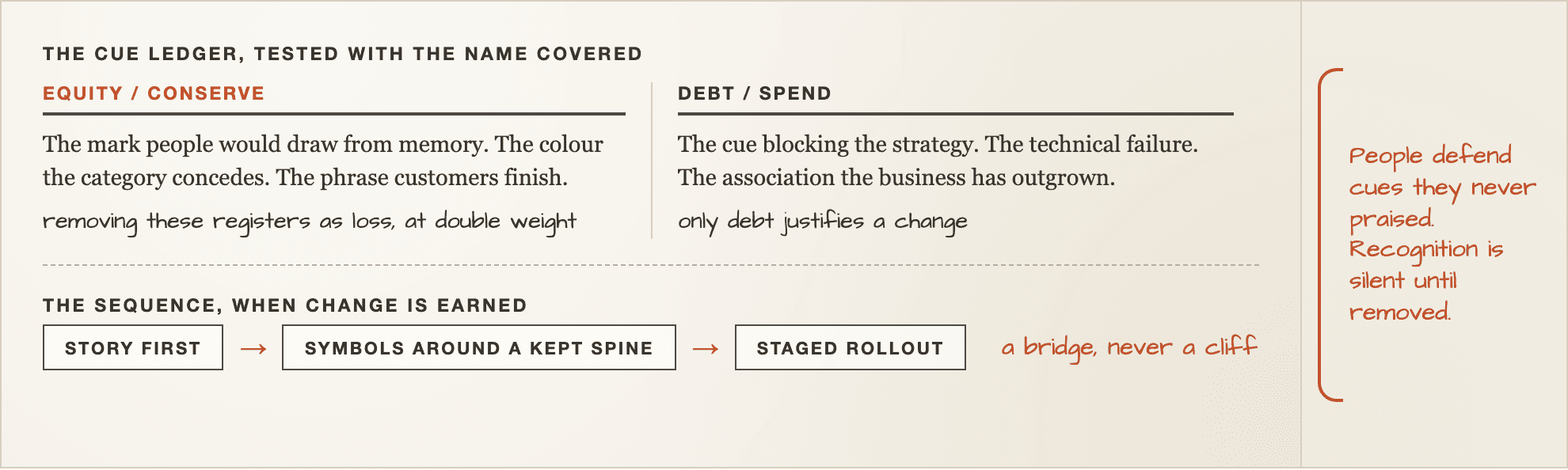
- Recognition system: which names, assets, phrases, and behaviours are already remembered and correctly attributed?
- Delivery experience: does the way the service is sold and delivered support the promise the brand wants to make?
Level one: repair the operating system
Choose repair when the underlying identity still fits but execution has fragmented. Different logo files circulate, colours fail accessibility requirements, templates disagree, social crops break, motion feels unrelated, or teams improvise because the guidelines fail to solve real use cases.
Repair lacks glamour, which is precisely why businesses skip it. Yet a well built operating system can make the same identity feel more deliberate without asking customers to relearn anything.
A repair project should leave the strategic meaning intact and produce practical files, responsive rules, content templates, asset governance, and ownership for future decisions.
Level two: refresh the expression
Choose a refresh when the current position remains relevant and credible, but the expression has lost clarity, flexibility, distinction, or contemporary usefulness. Becoming a different business is the wrong goal. The goal is to make the existing business easier to recognise and understand now.
A refresh may refine the mark, widen the colour palette, replace an impractical typeface, introduce a stronger imagery system, tighten the voice, and rebuild high value touchpoints. It should deliberately preserve useful cues rather than preserving every historical design decision.
Research into corporate visual identity change indicates that stakeholder responses vary by organisation and audience, and that communication about the change influences appreciation. The rollout story therefore belongs inside the refresh plan, even when the visual change appears modest.
Refresh test
If the same best fit customer should choose the business for the same central reason after the project, the work may remain a refresh.
Level three: evolve the brand system
Brand evolution sits between a refresh and a rebrand. The strategic centre still works, but the business has become more complex than the existing system can organise. New services, audiences, geographies, partners, or channels require clearer architecture and a larger expressive range.
The name and central recognition cues may remain, while the message hierarchy, service taxonomy, sub brand logic, proof system, tone range, and identity components are substantially rebuilt.
Evolution is often the right scope for an established service business that has grown through referrals. The reputation is valuable, but the market cannot yet see the full shape of the capability behind it.
Level four: reposition the business
Choose repositioning when the current market association restricts future growth. The business may be known for an entry level service, one legacy sector, one geography, one founder, or one delivery model that is no longer central.
Repositioning changes the comparison. It clarifies the customer situation, alternative, distinctive choice, consequence, and proof that should now lead. The offer architecture and customer experience must change with the language, otherwise the new position remains an announcement rather than a fact.
The existing name and some recognition assets may survive. Repositioning is deep because the meaning changes, never because every familiar cue disappears.
Level five: rebuild the brand
Choose a full rebuild when the name, architecture, position, reputation, identity, and operating model collectively preserve the wrong business. Typical triggers include a merger, legal constraint, severe reputation problem, category exit, major audience shift, or a name that makes the desired expansion implausible.
A full rebrand carries a larger memory and implementation burden. Research on service brand name changes found that customer evaluation can decline after rebranding, while closer fit between the new name and the service can reduce that decline.
Rebuild only after documenting what must be left behind and what equity can still travel forward. Even a new name can inherit familiar people, proof, service rituals, visual cues, or a transition phrase that helps customers cross the gap.
Rebuild test
A full rebrand is justified when continuity makes the future less believable than the cost of relearning makes it risky.
Measure recognition equity before changing familiar assets
Internal familiarity is a poor proxy for customer fatigue. Teams see the brand every day and often become bored with cues that customers encounter only occasionally. Measure before concluding that the market has moved on.
Audit unaided name recall, aided recognition, visual attribution, repeated customer language, branded search, direct traffic, referral shorthand, and the associations attached to each asset. Separate known from liked, and known from useful.
Distinctive asset guidance from the Ehrenberg-Bass Institute emphasises fame and uniqueness. An asset worth preserving should be recognised and correctly linked to the brand, then assessed for compatibility with the desired future.
- Known and useful: preserve or carefully evolve.
- Known but limiting: bridge during transition, then reduce.
- Unknown but strategically suitable: build through consistent use.
- Unknown and unsuitable: retire without ceremony.
Use a change depth decision matrix
Map the severity of the problem against the level of customer recognition. A shallow problem with high recognition calls for restraint. A deep strategic problem with low recognition creates more freedom. The difficult quadrant is deep change with high recognition, where continuity planning becomes part of the strategy.
Add implementation complexity as a third dimension. A service business with a website, proposals, and a small team carries a different rollout burden from a multi location organisation with contracts, signage, product interfaces, directories, partner assets, and regulated documents.
- Low problem depth + high recognition: repair or restrained refresh.
- Medium problem depth + high recognition: evolution with protected anchors.
- High problem depth + high recognition: reposition or rebuild with a formal bridge.
- High problem depth + low recognition: broader change is possible, but still requires operational proof.
Never use budget or timeline as the diagnosis
Cost and time determine what can be implemented, but they reveal nothing about what is broken. A business that needs repositioning never turns into a refresh because the budget is smaller. It becomes an underfunded repositioning project with hidden compromises.
Separate the required strategic scope from the rollout sequence. The business may make the full set of decisions now and phase lower priority touchpoints later. Conversely, a large budget is no licence to change assets that are already working.
Ask for the minimum viable change that resolves the problem and the complete roadmap required to finish the transition. This turns budget pressure into sequencing rather than strategic denial.
Test the scope before approving the identity
Test concepts with employees, customers, prospects, partners, and people with lighter familiarity. Never begin by asking which design they prefer. Ask what business they believe they are seeing, who it appears to serve, what feels familiar, and what seems to have changed.
Logo change research has found that familiarity, attachment, congruence, and surprise influence responses. A concept can be visually preferred while creating more recognition loss or strategic confusion.
Prototype real touchpoints: the homepage, proposal, social profile, service overview, onboarding email, and one proof story. A brand system should be judged where customers make sense of it rather than only on a presentation slide.
A diagnosis over thirty days before commissioning change
During week one, inventory the existing identity, messaging, service architecture, touchpoints, analytics, customer language, and recognition cues. During week two, interview customers, prospects, lost opportunities, partners, and the people responsible for delivery.
During week three, define the future business direction and score each brand layer as sound, strained, or broken. During week four, compare the five change levels, document the equity to preserve, and build a phased brief with evidence for every proposed change.
A moodboard is the wrong output. The output should be a decision: what must change, what must remain, what can wait, and how the market will understand the movement.
Before you use it
Questions that can change the recommendation.
What is the main difference between a brand refresh and a rebrand?
A refresh improves visual or verbal expression while the central position, customer, name, and business meaning remain stable. A rebrand changes the strategic meaning, offer system, audience, category, reputation, or identity required to support a different future.
Can a brand refresh include a new logo?
Yes. The logo can be refined or substantially redesigned inside a refresh if the underlying strategy and market meaning remain stable. The depth of design change, by itself, settles nothing about the strategic category.
When should a service business fully rebrand?
A full rebrand is appropriate when the existing name, position, architecture, reputation, and identity collectively make the desired business direction difficult to understand or believe, and a lighter intervention would preserve the constraint.
Is brand evolution different from a refresh?
Brand evolution is usually deeper than a refresh but more continuous than a full rebrand. It may rebuild message hierarchy, service architecture, identity range, and proof while preserving the name and central recognition assets.
How do you avoid losing brand recognition during change?
Measure existing recognition, preserve useful and distinctive cues, introduce new associations beside familiar anchors, explain the transition, phase the rollout, and track recognition separately from design preference.
Should cost decide between a refresh and a rebrand?
No. Diagnose the required depth first, then phase implementation to fit the available budget. Choosing a shallower strategy solely because it is cheaper can leave the original problem untouched.
Research record
What this guide draws from.
These sources establish the research principles used in this guide. Branding Tatva's framework is the practical application of that evidence to service businesses and founders leading their own brands.
- Corporate Rebranding: An Integrative Review of Major Enablers and Barriers to the Rebranding Process
International Journal of Management Reviews
A review of 76 rebranding cases that identifies major enablers, barriers, leadership requirements, and cross functional coordination needs.
- Corporate rebranding: effects of corporate visual identity changes on employees and consumers
Journal of Marketing Communications
A study of four organisations showing that responses to visual identity change differ by stakeholder and organisation, with communication influencing appreciation.
- Consumer reaction to service rebranding
Journal of Retailing and Consumer Services
A study of 320 customers across eight service rebrands examining attitude change after brand name substitution.
- Surprise! We changed the logo
Journal of Product & Brand Management
Research into how familiarity, attachment, surprise, and perceived congruence affect responses to a radical logo change.
- Brands of Distinction
Ehrenberg-Bass Institute for Marketing Science
Practitioner guidance on measuring distinctive assets through fame and uniqueness before changing or building identity cues.
- The Rebranding Process in Service Organizations: Influence Patterns of Core Service Characteristics
Administrative Sciences
A 2026 study arguing that service characteristics create rebranding constraints that differ from physical goods contexts.