Value proposition vs positioning vs tagline
The direct answer
Positioning defines the place a business chooses to occupy in a customer's mind. A value proposition explains the value of a specific offer to a specific customer. A tagline compresses a memorable expression of the brand into a short line. Positioning comes first, the value proposition translates it into an offer, and the tagline comes last.
Five conclusions
The argument, compressed.
- Positioning is the strategic decision beneath the language.
- A value proposition explains why a particular offer matters to a particular buyer.
- A tagline is a memory device, rather than a substitute for strategy.
- Writing them in the wrong order creates clever language without a stable meaning.
- The three tools should reinforce one another while performing different jobs.
Working framework · 5 decisions
The meaning ladder
Three layers move from internal strategic choice to customer facing value and, finally, to memorable expression.
Decision 01 / 05
Position
Choose the category, customer situation, difference, and evidence the brand should own.
Why these three terms get confused
Positioning, value proposition, and tagline often appear beside one another in brand briefs, pitch decks, and website projects. Because all three can eventually become sentences, teams begin treating them as different labels for the same piece of copy.
The confusion creates an order problem. A team starts by brainstorming a short line, then tries to make the business strategy fit beneath it. The resulting tagline may sound polished while the offer, audience, and difference remain unresolved.
The cleaner approach is to separate the decisions from their expression. Positioning decides the meaning. The value proposition makes that meaning commercially relevant. The tagline makes one part of the meaning easier to remember.
What positioning does
Positioning establishes the comparison a customer should use and the difference the brand wants to own. It includes the category frame, customer situation, competitive context, distinctive choice, and proof.
A positioning statement is usually an internal tool. It records the decision clearly enough to guide offers, messaging, identity, content, sales, and experience. Customers may never see the exact sentence.
Positioning should reduce choices. It helps the business decide which buyers receive the clearest value, which services deserve emphasis, which claims deserve repetition, and which opportunities sit outside the intended position.
Strategic distinction
Positioning explains why this business should occupy a particular place in the market. It is free to sound like something other than advertising.
What a value proposition does
A value proposition explains why a specific customer should choose a specific offer. It connects the customer's situation with the promised change, the method, and the evidence supporting the promise.
One brand can have several value propositions beneath one position. A consultancy may hold one market position while offering a strategy engagement, an audit, and an advisory retainer. Each offer needs its own reason for choice.
The value proposition should become more concrete than the brand position. It answers what the customer receives, why the approach fits their situation, and why the value deserves belief now.
- Who is this offer for?
- Which situation makes the offer relevant?
- What changes because of the offer?
- How does the method create that change?
- Which evidence supports the promise?
What a tagline does
A tagline is a short, repeatable expression attached to the brand or a campaign. Its job may be to signal a point of view, compress a promise, create emotional texture, or strengthen recognition.
A tagline carries less information than a value proposition. That limitation is useful only when the surrounding brand system already provides context. A short line cannot explain an unfamiliar category, customer problem, method, proof, and next step at once.
The strongest taglines earn meaning through repetition and experience. The line becomes valuable because the brand repeatedly demonstrates what the words refer to.
Positioning vs value proposition vs tagline
Positioning is a strategic choice. A value proposition is a commercial explanation. A tagline is a memorable expression. Each one becomes weaker when asked to perform the other two jobs.
Positioning can remain detailed because it guides internal decisions. The value proposition should be clear enough for a customer to evaluate. The tagline can be brief because it works beside the brand name, design, experience, and repeated messages.
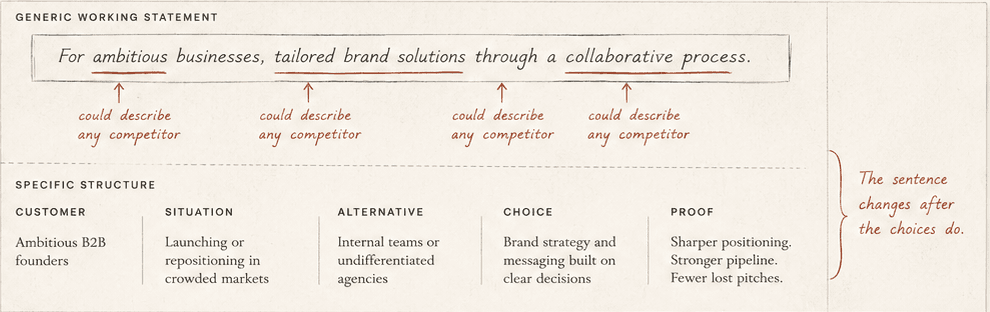
A practical test is to ask what happens when the sentence changes. If changing the sentence should change the audience, category, offer, or method, the work belongs to positioning. If it changes the reason to choose an offer, it belongs to the value proposition. If it changes the memorable phrasing while the strategy stays stable, it belongs to the tagline.
- Positioning: the market meaning the brand chooses to own.
- Value proposition: the value a specific offer creates for a specific customer.
- Tagline: a short expression designed to become familiar and memorable.
Which one should you write first?
Write the positioning first. Without it, the value proposition has no stable competitive context and the tagline becomes an exercise in verbal decoration.
Next, write the value proposition for the offer that matters most. Use the customer situation, promised change, method, and proof to create a clear reason for choice.
Write the tagline after the message architecture is working. By that stage, the team knows which meaning deserves compression and which language already feels natural to the brand.
Recommended order
Positioning first. Value proposition second. Message hierarchy third. Tagline last.
A service business example
Imagine a consultancy that helps established service businesses whose reputation is stronger than their market explanation. Its position may focus on turning founder held knowledge into a clear brand system for the next stage of growth.
The value proposition for a positioning engagement could explain that the client receives a category frame, audience decision, differentiation, evidence map, and message spine so the business becomes easier to understand and sell.
A tagline might then compress the wider belief into a short expression about becoming easier to recognise or remember. The tagline works because the position and offer already give it a body.
Common mistakes
The first mistake is using a tagline as the homepage's only explanation. New visitors still need orientation, relevance, proof, and a next step.
The second is writing one broad value proposition for every service. Different offers solve different parts of the customer situation and deserve distinct reasons for choice.
The third is treating positioning as a creative writing prompt. Strong positioning may sound plain because its first job is precision.
The fourth is changing the tagline whenever the campaign changes. A stable brand line needs time and consistent experience to accumulate recognition.
Audit your current language
Collect the positioning statement, homepage headline, service descriptions, pitch introduction, social bio, and tagline. Label the job each sentence is currently trying to perform.
Look for missing layers. A brand may have a tagline and several offer claims while lacking a clear position. Another may have a strong strategy deck while the website never translates it into customer value.
Rewrite only after the hierarchy is visible. The goal is less about producing more sentences and more about giving every sentence one clear responsibility.
- Can the position guide a decision beyond copy?
- Does each offer have a specific value proposition?
- Does the homepage explain the value before relying on a tagline?
- Does the tagline express a meaning the brand repeatedly demonstrates?
- Do all three layers reinforce the same central association?
Before you use it
Questions that can change the recommendation.
Is a value proposition the same as positioning?
No. Positioning defines the place the brand chooses to occupy in the market and customer's mind. A value proposition explains why a specific offer is valuable to a specific customer.
Is a tagline the same as a value proposition?
No. A tagline is a short memory device. A value proposition usually needs more detail because it explains the customer, situation, change, method, and proof behind an offer.
Can a business have several value propositions?
Yes. One brand position can support several offers, and each offer can have a distinct value proposition for the customer situation it serves.
Does every business need a tagline?
No. A clear name, position, message hierarchy, and distinctive identity can perform effectively without a tagline. Add one when it improves recognition or expression rather than filling empty space.
Where should a tagline appear on a website?
A tagline can appear near the brand name, inside the hero, or in repeated brand moments. It should sit beside enough context for a new visitor to understand the category and value.