How to use competitor research without copying the category
The direct answer
Use competitor research to understand the customer's comparison set, repeated category conventions, common claims, proof patterns, experience gaps, and neglected buying situations. Separate what customers need for category recognition from what competitors merely repeat by habit. Then choose which conventions to keep, which to challenge, and which distinctive choices your business can credibly prove. The goal is a better competitive decision, rather than visual or verbal imitation.
Five conclusions
The argument, compressed.
- Study the customer's real alternative set, including internal solutions and doing nothing, rather than only obvious competitors.
- Separate category conventions that aid comprehension from habits that merely make every brand look alike.
- Map claims and proof together because an unproven claim is a weaker competitive signal than a well supported one.
- Look past unused adjectives or colours to neglected buying situations and experience gaps.
- Competitive research should end with explicit choices about what to preserve, challenge, and own.
Working framework · 5 decisions
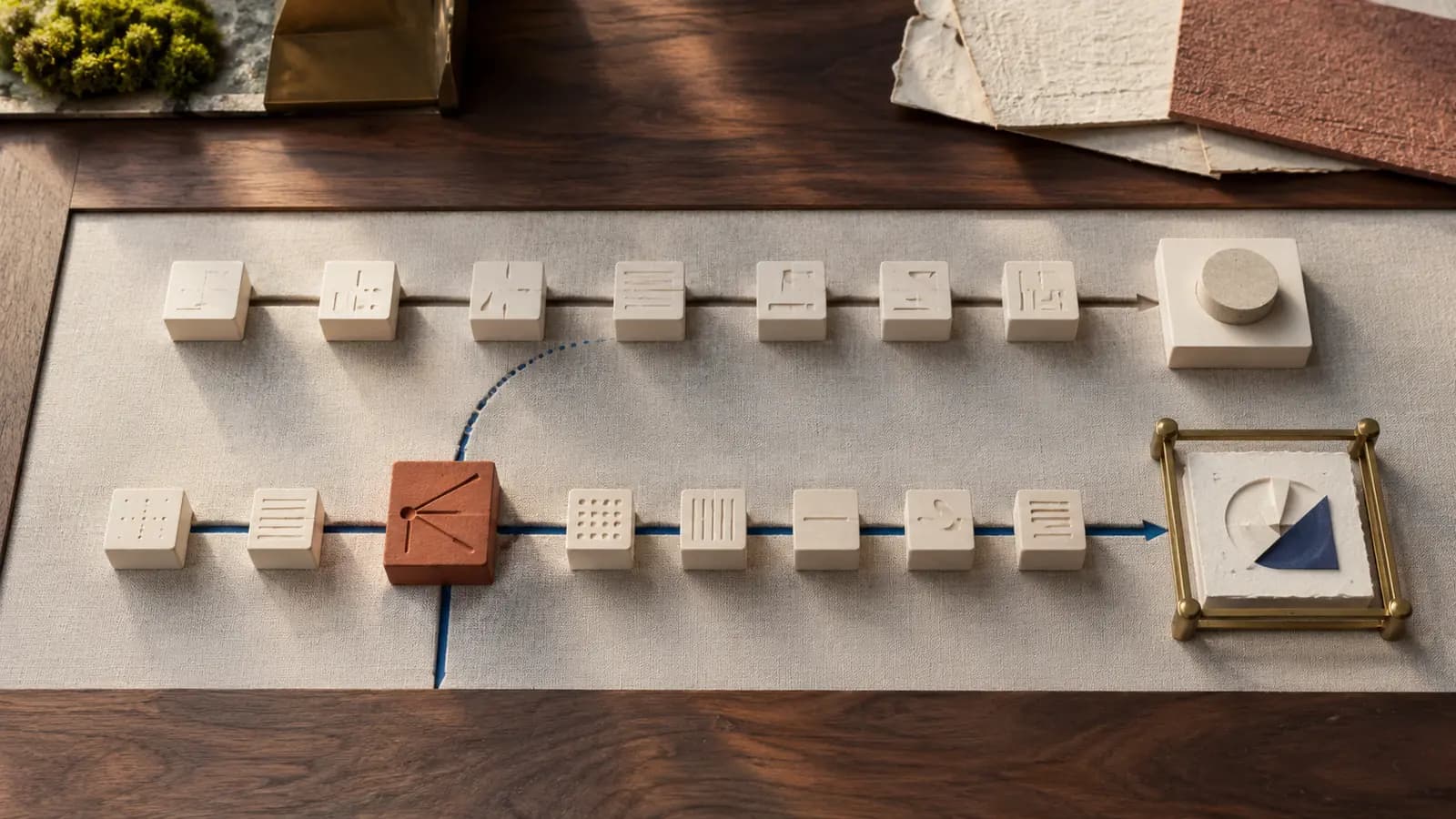
The competitive distance map
Five layers turn competitor observation into positioning choices instead of imitation.
Decision 01 / 05
Alternatives
Identify what customers actually compare, including substitutes, internal options, and delay.
Begin with the real comparison set
The competitor named in a strategy meeting may differ from the alternative inside the customer's decision. A prospect may compare an agency with a freelancer, an internal hire, a template, postponement, or continuing with the current system.
Interview customers and review lost opportunities to reconstruct what was genuinely considered. This gives positioning a commercial comparison frame rather than an industry directory.
Separate useful category conventions from copied habits
Some conventions help customers understand what they are buying. Others survive because each provider copies the previous one. Record recurring service structures, claims, visual cues, pricing language, case study patterns, calls to action, and onboarding promises.
For every convention, ask whether it reduces customer uncertainty, signals legitimate category membership, or simply creates sameness. Keep useful comprehension cues and challenge habits that hide meaningful differences.
Map competitor claims beside their proof
A market can appear crowded with identical claims while the underlying evidence differs sharply. Create a claim and proof matrix showing what competitors promise and how they substantiate it.
Look for proof gaps. If everyone claims strategic depth but shows only polished outcomes, a business that reveals diagnostic reasoning and implementation evidence may create more credible separation than another clever slogan.
Search for neglected buying situations
Whitespace often lives in a moment rather than a demographic. Competitors may all target growth while ignoring merger integration, founder transition, service sprawl, international expansion, or the point when referrals stop explaining the business clearly.
Map triggers, risks, desired progress, and alternatives by situation. A narrow situation can produce a sharper position without permanently shrinking the business to one industry.
Study the experience beyond the homepage
Competitive research that stops at websites overweights marketing expression. Review enquiry flows, proposals where available, public reviews, onboarding signals, response patterns, content, job listings, documentation, and customer language.
A distinctive position can emerge from how the service is delivered: senior access, decision speed, evidence discipline, implementation ownership, or a sequence competitors provide inconsistently at best.
Use visual research to measure sameness rather than harvest inspiration
Place competitor identities beside each other and identify repeated colour families, typography, imagery, layout conventions, motion patterns, and symbols. The purpose is to see the category's visual gravity.
Then decide which cues customers need for recognition and where the brand can build distinctive assets of its own. Moodboards should begin after this decision, otherwise competitive research can quietly become a shopping list of borrowed aesthetics.
End with a competitive decision sheet
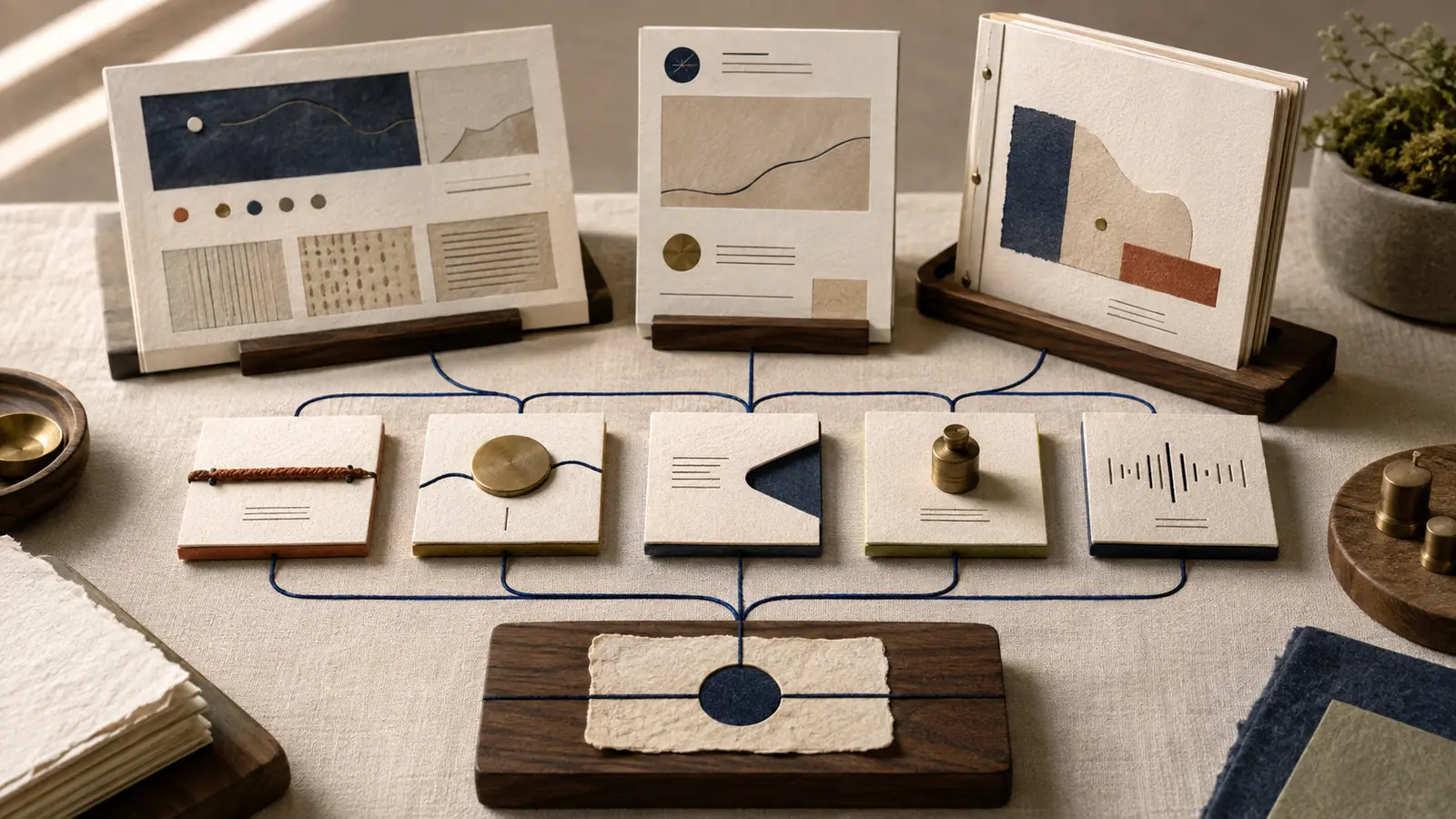
Summarise the research into four columns: preserve, challenge, avoid, and own. Preserve category cues that help comprehension. Challenge assumptions that create customer friction. Avoid claims or assets saturated across the market. Own choices the business can repeatedly deliver and prove.
Attach evidence and confidence levels. The sheet should guide positioning, messaging, identity, service design, and content rather than disappear after the workshop.
Refresh competitor research when the market changes
Competitor sets change as services expand, technology shifts, new entrants appear, and customers learn new category language. Review the map during major offer changes or planning cycles.
Track meaningful changes rather than every campaign. A competitor changing one headline is noise. A competitor changing category, audience, pricing model, delivery method, or proof architecture may alter the comparison frame.
Before you use it
Questions that can change the recommendation.
What should competitor research include for brand strategy?
Include the real customer alternative set, category conventions, positioning claims, proof, offers, experience signals, distinctive assets, buying situations, customer reviews, and important changes in the market.
How many competitors should a brand analyse?
Use a focused set that represents direct competitors, substitutes, aspirational references, and important alternative solutions. The aim is pattern recognition rather than an exhaustive directory.
How do you avoid copying competitors during research?
Record patterns analytically before collecting inspiration. Define what each convention does for the customer, then make explicit preserve, challenge, avoid, and own decisions before creative development begins.
Should competitor colours influence a brand identity?
They should inform distinctiveness decisions, but colour alone rarely creates a strong position. Evaluate the complete asset system and whether chosen cues can become attributable over time.
Can competitor research reveal positioning whitespace?
Yes, especially when it examines underserved buying situations, weak proof, experience gaps, and unclaimed strategic choices rather than searching only for unused wording.